

The Postwar Liberal Consensus: America’s New Moral and Constitutional Order
Article 5 of 11 in the America at 250 Series

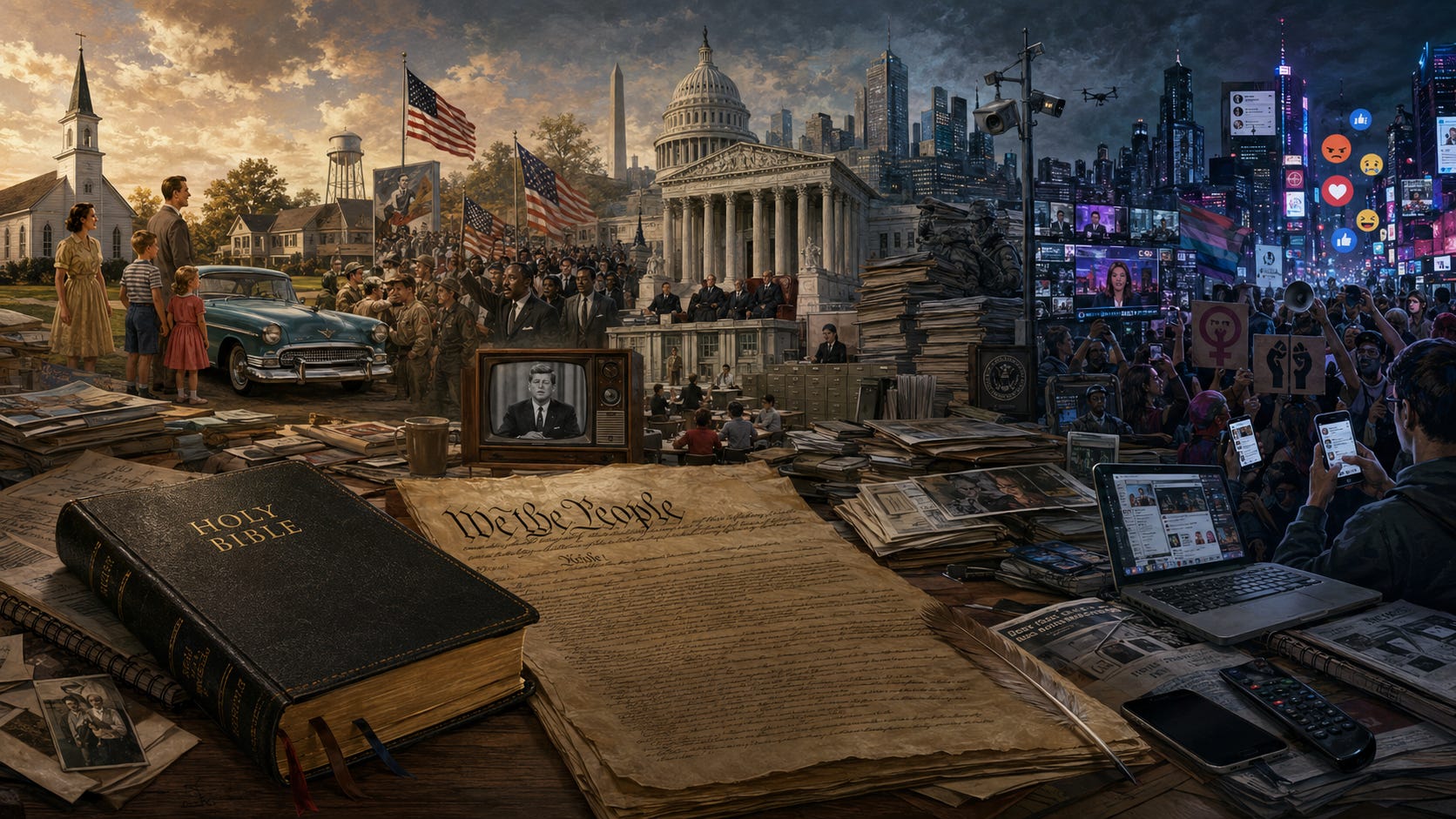
After World War II, America did not look like a nation in constitutional collapse. The country had defeated fascism. The economy was strong. Families were growing. Churches were full. Communism was the great external enemy, and Americans still spoke often of God, freedom, family, and country. Yet beneath that prosperity, the old order was continuing its decline.
The Progressive transformation had accelerated during World War II. After the New Deal had taught Americans to look to Washington for economic security, the war accustomed the nation to national planning, emergency power, federal coordination, bureaucratic management, and centralized command.
This period became the age of the postwar liberal consensus. While in many ways America still honored religion, liberty, and constitutional government, in practice the nation increasingly treated those things as useful traditions rather than binding truths. God was welcomed as a ceremonial reference, but less so as the sovereign Lord over law, liberty, family, sex, justice, economics, education, and civil authority. Thus, the postwar liberal order did not merely expand government programs, it created a new moral center. Courts, bureaucracies, universities, the media, national foundations, public schools, and federal agencies increasingly claimed authority to define justice, equality, rights, family, sex, race, life, and liberty.
The civil rights regime became one of the central ways this new moral center took constitutional form. We all should understand that discrimination based on the color of our skin is wrong; in Jesus Christ, the Bible makes clear that we are one people, and the only truly ultimate distinction is whether someone is in Christ or outside of Christ. But the constitutional question regarding discrimination was different: does the federal government have authority to compel private citizens to use their property and labor in ways they do not choose? In 1883, the Supreme Court answered no when it struck down the Civil Rights Act of 1875. The Court recognized that the Fourteenth Amendment restricts state action—“No state shall”—and does not directly regulate private individuals. Congress may restrain states from discriminating, but it may not, under that amendment, impose the same command directly on private persons simply because they operate private property.
By 1964, the real problem in our nation was not racial discrimination by private individuals but that Southern and border states had made it illegal for private business owners or public operators to choose not to discriminate or desegregate. Under the Fourteenth Amendment, Congress could have easily prohibited these laws. Instead, Congress went back to the blatantly unconstitutional language of the Civil Rights Act of 1875. This time, however, this infringement of the civil rights of property owners was upheld as a liberal Supreme Court expanded the meaning of the Commerce Clause beyond recognition. What had been unconstitutional in the nineteenth century became accepted in the twentieth because interstate commerce had been stretched to cover almost anything, including, after Wickard v. Filburn, wheat grown on a man’s own property for his own family’s consumption.
The next step our nation took under this new regime was the creation of the welfare state in 1965. This was designed to address the plight of blacks caused, according to the regime, entirely by white racism—we call this white supremacy or white privilege today. Unsurprisingly, the welfare state weakened families by transferring its ordinary duties of care to civil government and has failed to accomplish what it was designed to do. One example: while the overall black population in American has increased by 131 percent since 1959, the number of black families without a husband and father has increased by 223 percent.
Furthermore, if oppression by white racists is the leading cause of the low economic and educational status of blacks, we would have expected to see improvement in these areas as the government passed civil rights laws to end institutional racism and welfare programs designed to advance blacks economically despite continued racial economic discrimination. Yet just the opposite is true.
U.S. Bureau of the Census data show the difference in years of education between white and non-white males in 1940 was four years but by 1960 had shrunk to less than two. As blacks became more educated in the years before the civil rights and welfare legislation of the 1960s, their economic conditions also vastly improved. Thomas Sowell explains, “The rise of blacks into professional and similar occupations was faster in the five years preceding passage of the Civil Rights Act of 1964 than in the five years following its passage.” He continues, “As of 1940, more than four-fifths of black families—87 percent, in fact—lived below the official poverty level. By 1960, this had fallen to 47 percent. In other words, the poverty rate among blacks had been nearly cut in half before either the civil rights revolution or the Great Society social programs began in the 1960s.”
Once this new regime of rights was embraced by Congress, the Supreme Court, and the civil rights machinery, the logic did not stop with race. It moved from “you must not discriminate” and “you must pay to end the war on black poverty” to “you must affirmatively provide accommodations to the disabled,” and then more recently the support of rights related to sexual preference, gender identity, employment, cakes, photography, and other compelled uses of property and labor. The older constitutional limits—the Tenth Amendment’s reservation of undelegated powers, the First Amendment’s protection against compelled expression, the Fifth Amendment’s protection of private property, and even the Thirteenth Amendment’s rejection of involuntary servitude—were steadily pushed aside by a federal government claiming authority to define equality and compel private obedience to its moral vision.
The most devastating consequence of the new regime of rights has been the murder of about 66 million American children through abortion since Roe v. Wade. Despite our strong Christian, constitutional foundation, we have joined godless countries such as India, China, Pakistan, Nigeria, Indonesia, and Vietnam in giving our “children to offer them to Molech” (Leviticus 18:21) and sacrificing our “sons and their daughters to the demons,” pouring out their “innocent blood” (Psalm 106:37-38). There are already signs that abortion drugs may blunt or even reverse some of the post-Dobbs decline. A nation that decides the killing of children can be protected as liberty cannot remain morally sane.
And America has not. The sacrifice of American children continues as they are enrolled in public schools, colleges, and universities that serve as ministries of America’s godless moral order. They are training generations to think of truth as socially constructed, oppression as everywhere, and liberation as the work of political power. Identity politics has taken the biblically grounded language of rights and turned it against the biblically grounded idea of a common human nature. Man is no longer a creature made in the image of God. He is a bundle of racial, sexual, psychological, and political identities. Truth is tribal. Justice is a redistribution of power. Sin is simply oppression by the wrong groups. Repentance has become submission to the regime’s approved narratives.
And all of this is being enforced by the modern American Administrative State, a modern-day, power-wielding mandarinate designed to stifle the democratic response by sane Americans to the new constitutional order. The legislative and judicial branches of the United States government have been hard at work eliminating the democratic nature of our constitutional order by eviscerating the balance of power between the legislative, executive, and judicial branches of the federal government. Liberals complain about the imperial presidency in order to cover up their efforts to remove the ability of presidents like Ronald Reagan or Donald Trump to respond to the frustrations of Americans who elected them.
Where the modern critics warn us of an imperial president, though, America’s Founders feared something far more likely to occur: a congressional power grab. To counter the potential of a tyrannical Congress, Madison wrote “the weakness of the executive may require, on the other hand, that it should be fortified.” And fortify it they did, vesting the executive power in a single man, the “President of the United States of America.” Yet through laws (civil service, independent agencies, etc.) restricting the ability of the president to fire executive branch employees, the refusal of the current Republican Congress to allow recess appointments, and judicial interference in the execution of the laws of the United States, the fears of the Founders have come to life. No matter which party occupies the White House, the president cannot hire enough employees to meaningfully carry out the will of the electorate who put him in office if their will was to restore America to sanity.
Yet in the chaos of the current order, seeds of hope have been sown. The modern conservative movement came to life in the 1950s under the leadership of William F. Buckley Jr. It was launched in his book, God and Man at Yale, in which he pointed to the increasing godlessness and liberalism of the new regime at Yale. This took root in American politics with Ronald Reagan and has morphed into the Tea Party/MAGA populism we see today.
Similarly, the postwar period saw the rebirth of the evangelical church. Billy Graham, Campus Crusade’s Bill Bright, Francis Schaeffer, R.C. Sproul, and others brought biblical teaching back into churches. The Southern Baptist Convention was saved from following other mainline denominations into liberalism by Albert Mohler Jr. in the 1990s. And there has been a rebirth of reformed theology in more recent Presbyertian denominations as well as the SBC.
These developments have sown some hope for the future, yet they have done little to stem the collapse of America’s historic moral and constitutional orders in the present. They will not restore America by themselves. Sound theology confined to the pews of America’s churches will not address the fallenness of our nation. Constitutional mechanisms can restrain power only when they rest on a true account of God, man, sin, law, liberty, authority, covenant, and jurisdiction. But they are the kind of rebuilding that follows national repentance, from which reformation and restoration will follow. It is to this that we will now turn our attention.
Great installment!
Republicforusa.org